
How to Tell Your Love Story Without Writing a Biography
Write a warm, memorable love story for your wedding invitation by choosing meaningful moments, natural details and the right level of privacy.
The 'Our Story' section is often the hardest part of a wedding invitation. You are trying to compress something alive and private into a few paragraphs for an audience that ranges from childhood friends to relatives who have never heard the full version. The result can easily become a list of dates, an inside joke nobody understands or a grand declaration that does not sound like either of you.
A better story does not cover everything. It selects the moments that explain your relationship's character: how you noticed each other, what changed, what you built together and why this celebration feels like the natural next page. The goal is recognition, not documentation.
Find the one truth underneath the timeline
Ask what has remained true from the beginning. Perhaps you make each other braver, turn ordinary errands into adventures or became a calm home for one another across two cities. This underlying truth gives the story emotional shape. Without it, even accurate details can feel like a résumé.
Write the sentence privately before drafting for guests: 'This is a story about…' You may never publish it. Its job is to help you decide which memories belong. If a detail does not reveal that central idea, save it for a speech, album or conversation.
Interview each other before you write together
Separately answer a few prompts: What do you remember about the first meeting? When did the relationship begin to feel serious? Which ordinary moment captures the other person best? What have you learned to do together? Different memories create texture and prevent one voice from becoming the official history.
Compare the answers without correcting every discrepancy. One person may remember the weather; the other remembers the sentence that was said. The contrast can be charming. Agree only on facts that will appear publicly and on memories that both people are comfortable sharing.
- The first detail you noticed
- An ordinary ritual you now share
- A challenge that changed the relationship
- A place that feels like yours
- The moment marriage began to feel imaginable
Use a simple three-part arc
Begin with the spark: a meeting, friendship or unexpected second conversation. Move to the becoming: the repeated choices, distances crossed, families met or routines built. End with the present invitation: why you are excited to gather these particular people now.
This shape works because it moves. Avoid spending three quarters of the story setting up the first date and rushing the rest into one final sentence. Give the relationship after the beginning enough room to exist.
Choose small details over large adjectives
'We are best friends who love adventure' could describe thousands of couples. 'We still debate the playlist on every road trip, but never who makes the tea at the first stop' lets a reader see the relationship. Concrete details create warmth without requiring a dramatic writing style.
Use one or two details per paragraph. Too many names, locations and dates turn the reader into an archivist. Explain any inside reference in a way an unfamiliar guest can enjoy, or leave it private.
Read the draft aloud. Replace any sentence that makes both of you say, 'We would never talk like that,' even if it sounds conventionally romantic.
Let photographs add what the words cannot
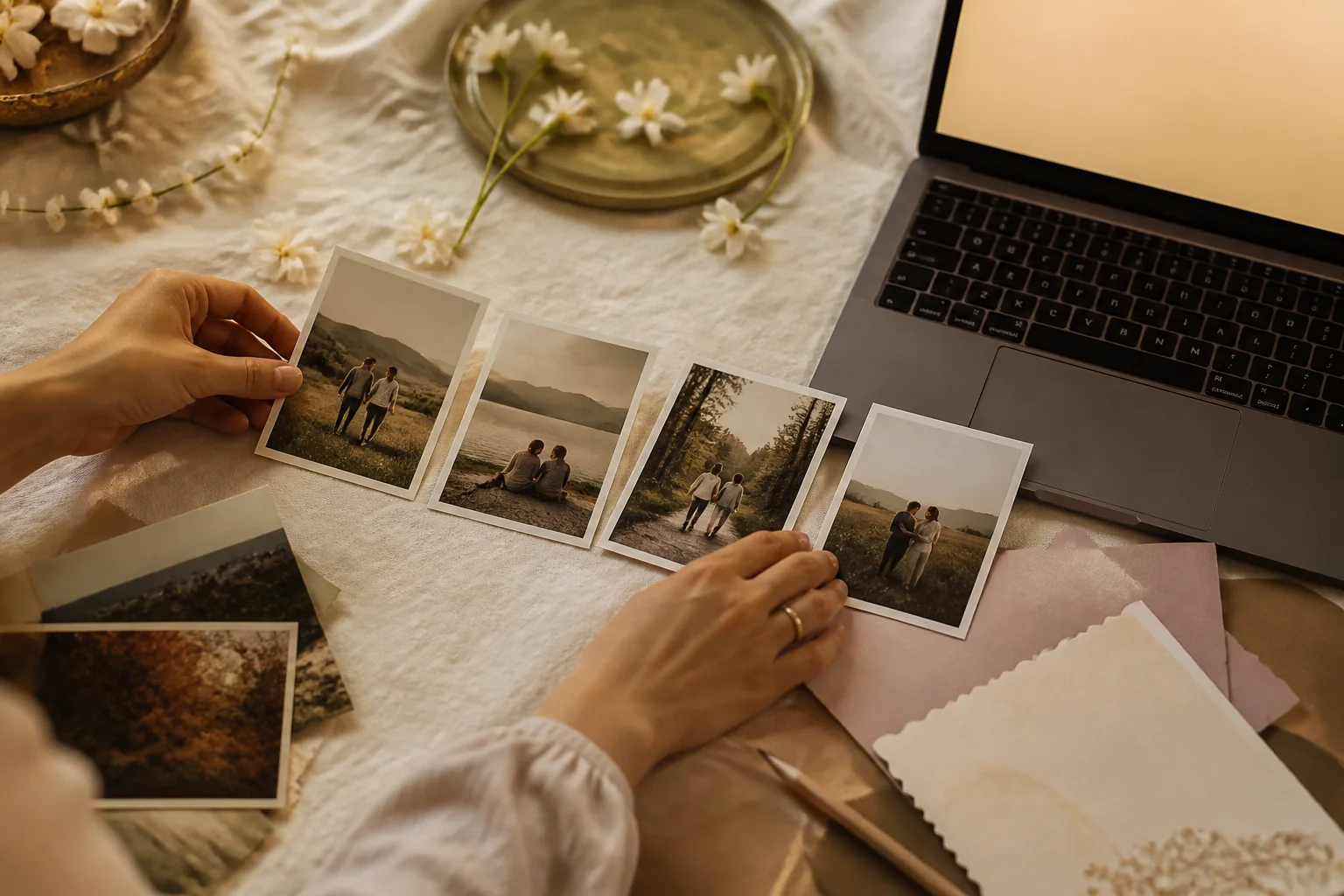
Choose a small sequence rather than a complete archive. An early imperfect photograph, a quiet everyday moment, a place with meaning and a current portrait can show time passing. Emotional variety is more compelling than a row of professionally posed images from one afternoon.
Write captions only when they add context, and keep them short. Protect friends and family who appear in old photographs by asking before publishing, especially if the invitation link is easy to forward.
Edit for rhythm, not maximum completeness
Aim for paragraphs that each do one job. Remove repeated versions of the same feeling, shorten the setup and keep the strongest image. A story can be tender at three hundred words; length alone does not make it meaningful. On a phone, generous spacing and short paragraphs make reflection feel inviting rather than demanding.
If the two voices are distinct, consider alternating short passages or using a brief line from each person. Do not manufacture disagreement for charm. The form should reveal your real dynamic, not imitate another couple's page.
Choose a privacy boundary before publishing
Some memories belong to the couple, not the invitation. Avoid details about past relationships, family conflict, health, finances or a difficult period unless everyone affected has freely agreed. A forwarded link can travel beyond the intended guest list, so write for that possibility.
You can still acknowledge depth without disclosing the full story: 'Through seasons of change, we learned how to make a home in one another.' Privacy is not emotional dishonesty. It is an intentional frame around what you are ready to celebrate publicly.
Frequently asked questions
How long should our wedding love story be?+
For a digital invitation, roughly three to six short paragraphs is often enough. Use the length your story needs, then edit for a comfortable mobile read.
Should the love story be written in first or third person?+
First-person plural usually feels warm and immediate. Third person can suit a formal tone. Choose one perspective and keep it consistent.
What if one partner does not want an Our Story section?+
Do not force it. Use a short welcome note, a photo sequence or no story at all. A personal invitation can respect different levels of public sharing.
Put the guide into practice
Create your wedding invitation
Start with a polished template, add every event and share one mobile-friendly link with your guests.
Explore templates